

Pink, Power, and Performance: Marie Antoinette Style

Updated: Mar 7
The Marie Antoinette Style exhibition at the V&A, South Kensington unfolds as a theatrical experience, beginning with a soft yet striking pink entrance that immediately frames Marie Antoinette as one of history’s most fashionable, scrutinised, and controversial queens. Creating a feeling both romantic and commanding. The title, rendered in bold red calligraphy, commands attention by mirroring the way Marie Antoinette herself used fashion to stand out within the rigid structure of the French court.

Passing through an archway, the lighting shifts dramatically: the rooms darken, chandeliers glow, and spotlights fall carefully onto gowns that quite literally take your breath away. Walking through the exhibition, I was constantly aware that clothing was never “just clothing” for Marie Antoinette. It was identity, theatre, and strategy.
At just fourteen years old, Marie Antoinette made her entrance into French court society. In an environment governed by strict dress codes and tradition, she challenged convention by embracing the female form through new silhouettes, drawing inspiration from foreign influences and the latest Parisian fashions. Her approach to dress positioned her not only as a queen, but as a style icon whose influence extended far beyond Versailles.


Among the garments displayed is the wedding gown of Duchess Hedvig Elisabeth Charlotta (1759–1818), a French-style court dress made of silver brocaded silk. The gown closely resembles the one worn by Marie Antoinette for her own wedding, for which silk was ordered from Paris at enormous expense by her mother, Empress Maria Theresa of Austria. The dress on display is itself a copy of a gown worn by Marie Antoinette’s sister-in-law, the comtesse d’Artois, at her wedding in Versailles in 1773. Standing in front of this gown, I found myself lingering. The corseted structure, the precision of the silhouette, and the hand-sewn embroidery are astonishing, almost overwhelming in their detail. It’s impossible not to imagine the months of labour stitched into every seam.
Another highlight is a robe à la française crafted from soie changeante, shot silk, one of Marie Antoinette’s favoured fabrics. Woven with a pink warp and yellow weft, the silk shimmers softly as the light moves across it. The colour feels delicate yet opulent, and the pleated back and refined edging are exquisitely crafted. I found myself completely in awe of how something so light could feel so powerful.


The exhibition then introduces a robe à la française worn à la polonaise, reflecting a shift in fashion during the 1770s toward more informal and expressive silhouettes. In this style, the skirts are looped up to create volume and movement, a trend Marie Antoinette eagerly adopted. Although newer in appearance, similar shapes could be achieved by adapting older styles, as seen in this elaborately trimmed gown. The floral embroidery and lace detailing suggest months of meticulous work, underscoring the extraordinary skill involved in its production. This garment captures Marie Antoinette’s role in redefining court dress by softening formality while maintaining luxury.


Accessories play a starring role throughout. A pink silk domino, worn at masquerade balls, immediately caught my attention. Fastened with bows at the front, it reflects the evolution of fashion over the years, with oversized maxi-bows now appearing across a range of brands, from high-street to luxury. Marie Antoinette’s shoes were another highlight. In her early years at court, she received four new pairs every week, mastering the famous “Versailles glide.” One beaded pink silk slipper with a delicate heel stood out in particular, elegant and impossibly refined. I couldn’t help but think how extraordinary it must have been to live in a world where beauty extended even to the smallest details. I’d give anything to have her shoe collection now.
The jewellery on display is mesmerising. During Marie Antoinette’s reign, jewels became bolder, more innovative, and designed to catch the light. Bow motifs reappear again and again, instantly recalling contemporary collections such as Prada’s Eternal Gold. Seeing these connections brought the exhibition to life, effortlessly linking centuries.
I couldn’t write this piece without mentioning one of Marie Antoinette’s most iconic accessories. Behind glass, seven fans are displayed, each a meticulously decorated masterpiece, adorned with lace, embroidery, and painted scenes. The queen was famously “never without a fan,” and here, they transcend mere accessories, feeling more like delicate, handheld works of art. This section felt especially intimate, offering a rare glimpse into her private rituals of elegance.


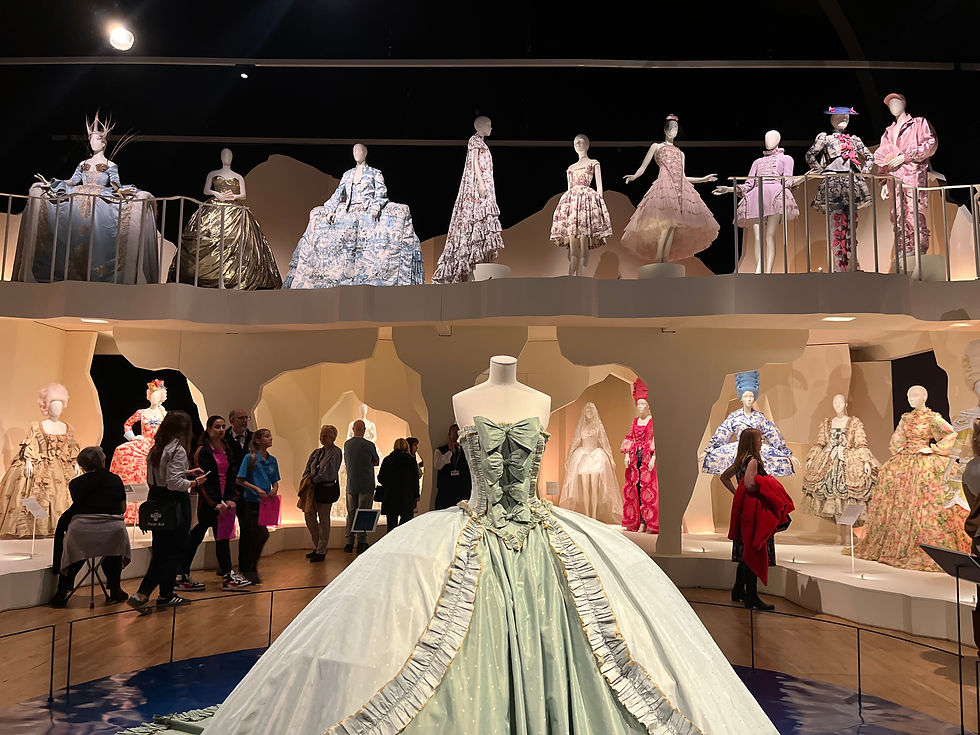
The final rooms are nothing short of breathtaking. At the centre stands a pastel green shot-silk gown by John Galliano for Christian Dior Couture Spring 1998, created as a direct tribute to Marie Antoinette’s court dress. Surrounded by costumes from Sofia Coppola’s Marie Antoinette (2006), designed by Milena Canonero, and garments from The Great, the exhibition draws a clear line from Versailles to the modern runway. Moschino’s Fall/Winter 2020 “Let Them Eat Cake” dress adds a bold, playful reinterpretation of history through the lens of pop culture and satire.
By the end, I felt genuinely overwhelmed in the best way. This exhibition goes beyond fashion, it feels like a carefully curated work of art. The clothing, shoes, jewellery, and fans come together to create something immersive, emotional, and deeply considered. As visitors exited, the words above greeted us: “We have dreamt a pleasant dream, that is all” (Marie Antoinette, February–March 1793). It felt like the perfect farewell, leaving me in awe, slightly breath-taken, and still captivated by its elegance long after leaving.
Photos & Written by Laura Robinson


